What a Failing Sewer Lateral Sounds Like Before It Backs Up
The sewer lateral usually sends a signal weeks before it actually fails, and most of the signals get ignored.
September 17, 2026 · 3 min read
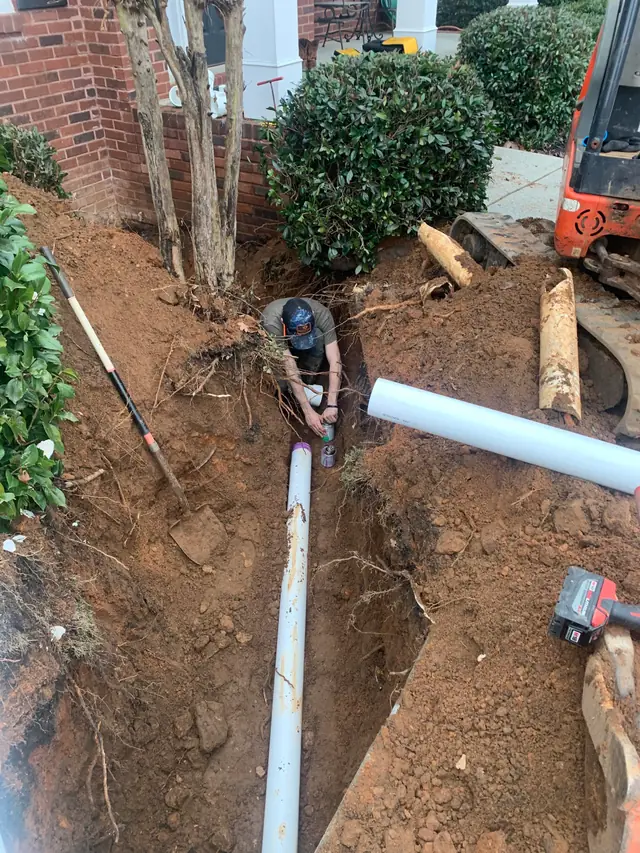
A sewer lateral is the pipe that carries wastewater from the house out to the street, and most homeowners in Gainesville and Cumming never think about it until it stops working. Unlike a kitchen faucet or a water heater, nobody sees it. It just keeps doing its job underground for decades, right up until it doesn't.
Gurgling in the toilets
A toilet that gurgles on its own, or gurgles when a washing machine drains somewhere else in the house, is air pushing back through the trap. That happens because the lateral isn't draining freely downstream, and the air has nowhere else to go but back up through the water seal. It's usually root growth or a partial collapse further down the line, not a problem with the toilet itself. Because every fixture in the house shares that same lateral, a gurgle that shows up in one bathroom is often the earliest warning the whole system gives.
Sewer gas odor inside the house
Every drain in a house has a trap that holds a small amount of water and blocks sewer gas from coming back up into the room. If that smell shows up inside the house, something downstream is letting the line vent where it shouldn't, usually a break or an open joint. This is one sign worth acting on quickly rather than waiting it out.
Every drain running slow at once
One slow drain is usually just that fixture. Every fixture in the house running slow at the same time, toilets, tubs and showers together, points somewhere else entirely. When the whole house backs up together, the problem is the main line carrying everything out, not the sink or tub someone happened to notice first.
Foul odor or water sitting in the yard
A lateral that has cracked or collapsed starts losing its contents into the surrounding soil before it ever fully blocks. That shows up as a soft, wet patch of yard that never quite dries out, sometimes with a smell that gives it away before the ground does. A camera finds the exact spot, and the excavator opens only that spot rather than the whole yard.
What root infiltration actually looks like underground
Roots don't attack a solid pipe. They find a hairline crack or a loose joint, usually where the pipe was already weakest, and grow toward the moisture and nutrients inside the line. Once a root gets a foothold it thickens every year, and what started as a thin filament through one crack becomes a mat that catches paper and grease until the line blocks completely.
- Root infiltration, thickening year over year at a single joint
- Broken, cracked, or collapsed pipe from ordinary age
- A section that was never good pipe to begin with
- Ground shift settling a low spot that traps solids over time
On a sewer line repair, new PVC pipe goes in and roots get cleared off it by hand before the trench closes, so nothing sits against fresh pipe with a root still touching it.
Spot repair versus a full lateral replacement
Not every failing lateral needs to come out end to end. A single collapsed section or one bad joint, once the camera has located it precisely, often gets a spot repair, a short section dug up and replaced rather than the whole run. A lateral with root infiltration spread across its length, or one made of old clay pipe nearing the end of its life everywhere at once, is a different conversation. Patching one spot on a line that's failing everywhere just moves the next call a few months down the road.
Age matters as much as the symptom does. A lateral installed decades ago, even one showing just one bad spot today, is usually close behind that spot in every other joint along the run. Camera footage turns that guess into an actual decision, rather than replacing a line that only needed one repair, or patching a line that needed to come out. Material matters too, since old clay and old cast iron age differently than the PVC that replaces them today.
Any of the signs above are worth a camera inspection before the line finishes failing on its own schedule instead of yours. Fortune Plumbing serves Gainesville, Cumming, Oakwood, Flowery Branch and the towns around them, and can be reached at (770) 532-9489 or by text at (770) 295-9117.
Fortune Plumbing, (770) 532-9489
Call (770) 532-9489More articles
Why a Camera Goes Down the Line Before the Snake Does
A blocked drain has more than one possible cause, and guessing wrong turns a twenty minute fix into a dug up yard.
Two Ways a North Georgia Water Service Line Actually Fails
The pipe that feeds a whole house from the street usually fails for one of exactly two reasons.