Water line specialists
The pipe that feeds the whole house
The water service line is the pipe that supplies water to a home or business. When it fails, we locate it, decide between a spot repair and a full replacement, and dig only where the problem actually is.
Chapter 01
The pipe that supplies water to a home or business
The water service line is the pipe that supplies water to a home or business. It runs from the meter, usually somewhere near the street, back to the house, and every fixture inside depends on that one run staying intact. Most people never think about it until it fails, and when it fails, the sign is rarely a puddle in the yard. It is a single pipe doing a lot of quiet work, and it is buried deep enough that nobody checks on it until something upstairs stops behaving the way it should.
More often it is a water bill that climbed for no obvious reason, or pressure that has been quietly dropping for a few weeks. Fortune Plumbing has been digging up and putting back these lines around Gainesville, Cumming and Oakwood since 1989, and by now the pipe in the ground tells a short list of stories.
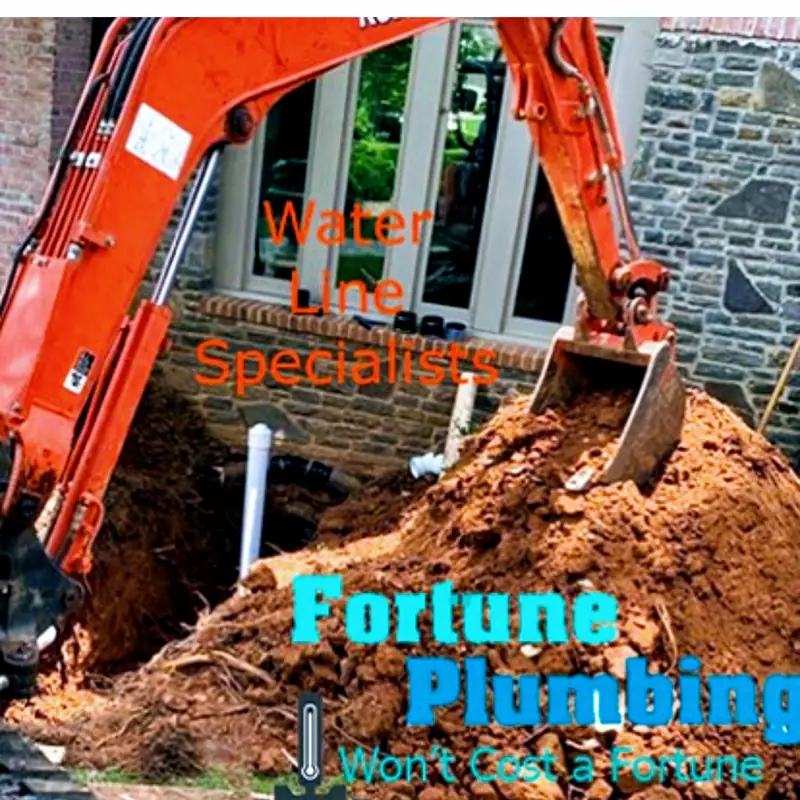
A Fortune Plumbing excavator part way through a water service line dig on a North Georgia property
Why they fail here
Two causes cover most of the calls. The first is natural wear and tear of the water service pipe, where the pipe has come to the end of its expected lifespan, as is the case with most galvanized water lines. Galvanized was standard for decades, and a lot of what is still in the ground around North Georgia is well past the age where it holds up. The coating goes first, the iron underneath starts rusting from the inside, and the bore narrows until pressure suffers long before anything actually splits open.
The second cause is that the original pipe used is of poor quality, such as thin-wall blue poly. Poly pipe on its own is not the problem. Thin-wall poly, installed cheap on an older build to save a few dollars, is, and unlike galvanized it tends to go all at once rather than slowly. We usually know which one we are dealing with within a few minutes of getting a probe or the camera on the line.
Chapter 03
Spot repair or full replacement
Not every failing line needs to come out end to end. If the camera and the locate point to one bad section, a spot repair opens the smallest trench that reaches it and replaces that run, nothing more. If the line is old enough that one failure means the rest of it is close behind, full replacement is the honest answer, and we say so before anyone breaks ground. Age and material tell most of the story before we even look at the specific break, since a galvanized line that just failed once is a line that is going to fail again somewhere else on the same run before long.
Either way the decision gets made from what we actually find in the line, not from a guess made at the curb. That is the difference between paying for the repair the pipe needs and paying for the repair that happened to be easiest to sell.
The dig, and putting the yard back
Once we know exactly where the run is, the excavator opens that run and nothing beside it. A water line dig on a residential lot is not a construction site, it is a trench the width of the pipe, dug to the depth the line actually sits at, whether that is a shallow run under a flower bed or a deeper crossing under a driveway.
New pipe goes in, the connection gets pressure tested before anyone backfills, and the trench closes over it the same day where the job allows. Gary Fortune has run this shop under his own name since 1989, and a water line dig that leaves a yard worse than it found it is not the kind of job that keeps a company in business for thirty seven years.
Fortune Plumbing, Family-owned and operated since 1989. Call (770) 532-9489.
Repair Your Main Water Line Today
The water service line is the pipe that supplies water to a home or business. Around here it fails in two predictable ways.
- Natural wear and tear of the water service pipe, where the pipe has come to the end of its expected lifespan, as is the case with most galvanized water lines
- The original pipe used is of poor quality, such as thin-wall blue poly